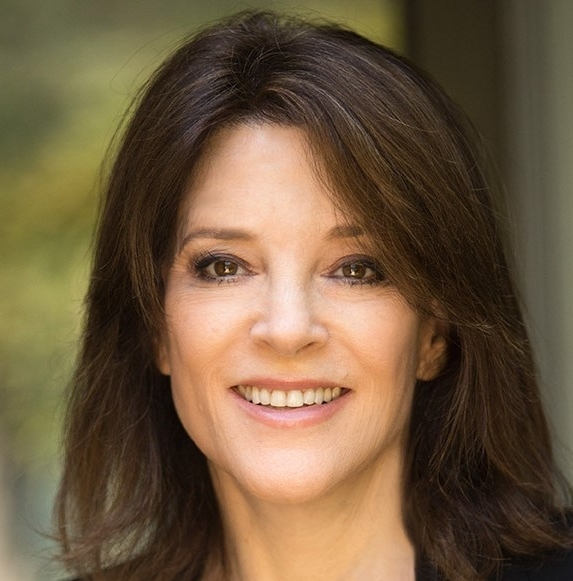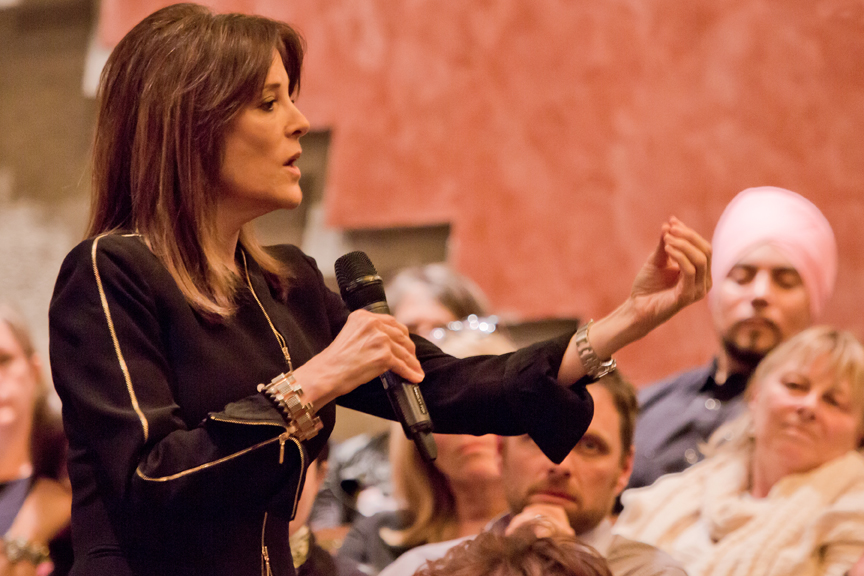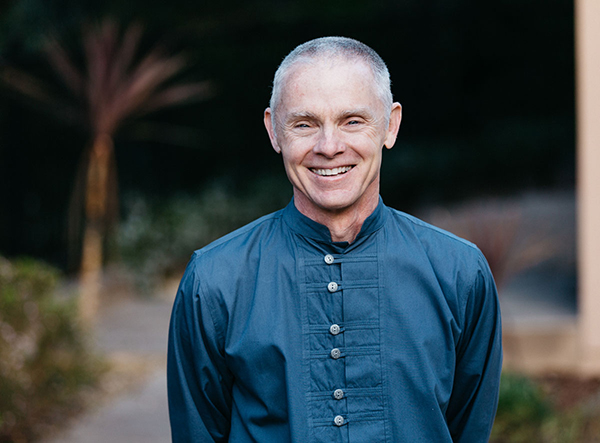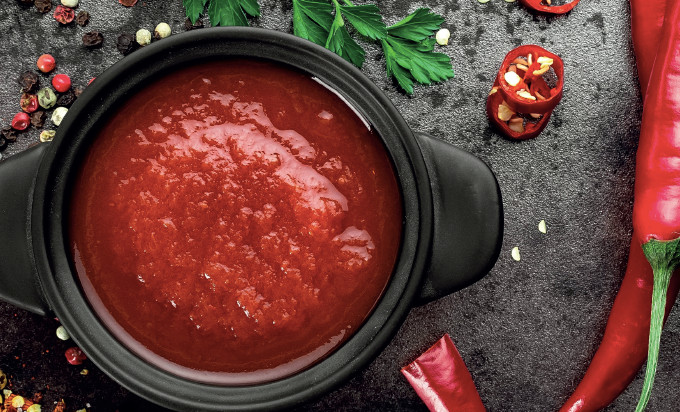
In this sneak peek of Calodagh McCumiskey’s article from our Spring 2019 issue, she shares how astrology can be used as a vehicle for growth and transformation: themes that are very relevant to the season! To read the full article, just pick up a copy in your local stockist or subscribe here.

sneak peek
In this sneak peek of a powerful article from our Spring 2019 issue, Davie Philip discusses how we can use new stories of hope and resilience to inspire ourselves to tackle the challenges facing our planet. To read the full article, pick up a copy of the magazine at your local stockist or subscribe here.
Autumn 2018 Sneak Peek: Our Exclusive Interview With Marianne Williamson
We are thrilled to share this sneak peek of our exclusive interview with the renowned spiritual teacher and author Marianne Williamson, which appears in our Autumn 2018 issue. Click here to find a stockist near you, or subscribe to receive a copy straight to your door.

Marianne Speaks
We interview Marianne Williamson ahead of her Dublin trip
by Aisling Cronin
Marianne Williamson is one of the world’s most renowned spiritual teachers, authors and speakers. Seven out of her twelve published books have been New York Times bestsellers. One of her powerful statements in the classic A Return to Love – “Our deepest fear is not that we are inadequate. Our deepest fear is that we are powerful beyond measure. It is our light, not our darkness, that most frightens us” – has become a guiding light for spiritual seekers around the globe.
When we asked her to summarise her extraordinary career, Marianne simply said, “If I’ve learned anything, it’s that life isn’t about the big dramatic moments that stand out, so much as it is about the consistent effort to live a better life. It’s up to us to make any one moment stand out, by standing tall within it.”
Marianne will be speaking in Ireland on Wednesday October 10th 2018, from 7.30 to 9.30 p.m. in the Royal Marine Hotel, Marine Road, Co. Dublin. Ahead of what is sure to be an inspirational talk, we spoke to Marianne about her thoughts on Ireland, world politics, Aretha Franklin, and how the famed A Course in Miracles – a remarkable 1976 book written by Helen Schucman, who said that she channeled the words directly from Jesus – has touched her life.
During your seminar in Dublin, you’re planning to talk about how we can learn how to transform our lives for the better, based on the insights you have gained from A Course in Miracles. We would love to know more about that subject. Have you had the opportunity to travel to many places in Ireland before, or are there any particular locations in the country that are special to you?
One trip I took that remains with me is when I went to Knowth and Dowth. Extraordinary. What amazes me about Ireland is that, unlike most civilisations, it was as amazing in ancient times as in contemporary times. That’s not all that common, you know. Newgrange and James Joyce? Seriously. Not many countries can claim that kind of thing.
The world has heard a lot about Ireland recently, and I’m curious about your own transition from external emphasis on religious dogma to the internals of spiritual growth. Obviously there have been some tragic lessons learned, and hopefully the principles of A Course in Miracles can help to shed some light on your path ahead. People studying and teaching the Course in Ireland are doing tremendous work, and I just hope I can add to the conversation with whatever insight I’ve gleaned.
The teachings within A Course in Miracles have been central to your life and work over the years. When did you first encounter this book, and what is the greatest gift that its teachings have given you?
I first saw A Course in Miracles when I was in my mid-twenties. The greatest thing it has taught me is that the lesson to be learned is always my own: my own need to forgive, to rise to the occasion, to be kinder, to be more generous, to accept people as they are, to be less judgmental. There’s always a temptation to make the problem about other people, but the Course is adamant that the work is always on ourselves.
‘Only a politics of love overrides a politics of fear.’ This is a truly beautiful quote from your book Healing the Soul of America, and as the book celebrates its twentieth anniversary, that quote has never been more timely. What do you envisage when you speak of a ‘politics of love’? We all know what a politics of fear looks like – all we have to do is switch on our television or read the news online – but how do you envisage politicians, or indeed, ordinary people relating to each other when they come from a place of pure love?
The same principles that guide us in our individual lives should guide our politics. If the point is to be a good person, then the point should be to be a good society. A good economy. And so forth. I think the economic principles that now organise our societies should be replaced by humanitarian ones. We’ve allowed money to become a false god, seen as the source of human happiness; but in fact, it’s the other way around. Money doesn’t create happiness so much as happiness creates money. When people are happy we’re naturally creative. We naturally manifest. A politics of love is one in which we see love as the bottom line, politically and economically as much as in our personal interactions. Politics is the work of our collective journey, and the effort to increase our compassion should be a political as well as a personal goal.
To read the full interview, pick up a copy of our Autumn 2018 issue in a stockist near you, or subscribe
to get a copy delivered to your door. Marianne’s upcoming Irish seminar will take place on Wednesday October 10th 2018, from 7.30 to 9.30 p.m. in the Royal Marine Hotel, Marine Road, Co. Dublin. For more information and tickets, go to seminars.ie. To learn more about Marianne and her work, go to marianne.com.
Sneak Peek: Our Summer 2018 Interview with Adyshanti
Our Summer 2018 issue has officially hit the shelves, and we couldn’t be more excited! We wanted to share an exclusive sneak peek of our interview with the world-renowned spiritual teacher Adyashanti (this issue’s cover star). He spoke to us about awakening on different levels of our being, the student-teacher relationship, and what Ireland means to him. Adyashanti and his wife Mukti will be visiting Dublin this August. To read the full interview, pick up a copy of the Summer issue in your local stockist, or subscribe online today.
The Wisdom of Adya: Opening up and embracing what is
by Aisling Cronin
Interviewers: Daizan Kaarlenkaski and Paul Congdon
Adyashanti is an American-born spiritual teacher who is devoted to serving the awakening of all beings. He promotes non-dual teachings, based on recognising both the infinite spiritual possibilities and the everyday simplicity of our lives. He is the author of a number of successful spiritual titles, including The Way of Liberation, Resurrecting Jesus and Falling into Grace. We were thrilled to interview him recently and hear about his thoughts on the student-teacher relationship, his relationship with his wife Mukti, working with his father, and what Ireland means to him.
Could you tell us about the way you share your dharma teachings? For example, you never answer questions directly, but instead offer questions for people to ask themselves.
When I am dialoguing with somebody, my goal is to help them discover an answer or a resolution inside themselves, for themselves. All true realisations come from within the individual. In my style of teaching, I put a lot of responsibility on the students because I think that in the spiritual community, the students are far too often infantilised and treated like children. It is often encouraged for students to relate to the teacher as a child would, rather than interacting as two adults in a state of mutual trust. Grown-ups make their own decisions.
Do you think there can come a point when the student-teacher relationship needs to evolve for the student to gain true autonomy?
Yes, I think if a student has too much projection around the teacher – if they’re projecting all of their own holiness and light onto them – then the teacher does become a barrier. People put these projections onto the teacher because they hope that the teacher is going to be able to ‘save’ them. To the extent that we allow ourselves to become involved in that projection, the projection is what becomes a barrier. I was with my teacher for about fourteen years before she asked me to teach, and I noticed then that our relationship changed. I was still open to what she had to say, and open to her direction and guidance, but I related to her as an adult and not as a child. Teachers are best regarded as mentors, rather than as ‘gods.’
How do your teachings translate into your day-to-day life, in terms of your relationships?
Mukti and I have one of the most harmonious relationships that I know. I’m not saying it’s the most harmonious relationship in the world or anything, but it’s always been something that comes relatively naturally to both of us, which is really lucky. It has felt so natural for us to be together and part of that may be because we never imagined that it was the other person’s responsibility to ‘make me happy’. It has certainly matured over time. It had a lot of those effortless qualities from the very beginning, but nothing stays static – you are either maturing or regressing, one or the other. For twenty-two years, I have kept thinking to myself, ‘it can’t get any more profound than this’ and the next year, I find myself thinking, ‘wow, it did!’ Relationships can be one of the greatest areas of growth there is. To have a successful relationship, you’ve got to be a clear, adult, mature human being. That applies to relationships of all kinds: lovers, friends, family, even strangers.
Adyashanti and Mukti will be visiting Dublin this August for a Special Intensive teaching event. This will take place from 11 a.m. to 6 p.m. on Sunday August 19th, in the Gibson Hotel, Point Square, North Dock, Dublin 1. For details, go to: www.adyashanti.org
In this sneak peek of Davie Philip’s article from our Spring issue, he talks about the hidden gifts that introverts have to offer to the world, and how they can learn to embrace and express them. The full article is available in our new magazine, which can be obtained at your local stockist or through a subscription.

By Davie Philip
“Everyone shines, given the right lighting. For some, it’s a Broadway spotlight, for others, a lamp lit desk.”
Susan Cain
“David was a quiet wee laddie,” according to someone I went to school with whom my mother met recently in the Scottish town where I grew up. Although I now intentionally live in community and work as a group facilitator, I definitely have introvert tendencies. In an extrovert-dominated culture that appreciates the loudest and most outgoing, how do we ensure that the voices and contributions of people who are not as comfortable putting themselves out there are valued?
Over the years I have managed my social awkwardness and overcome a fear of public speaking and am now very comfortable addressing and working with large groups. That is, as long as the focus is on sustainable community or another topic that I am passionate about. Outside of my bubble I can lose my flow, be very quiet and sometimes be severely inhibited.
It was Carl Jung who first coined the terms introvert and extrovert, to describe his observations that people tend to be energised either by going inward in quiet reflection, or outward and are invigorated through interactions with people. Of course, it is a spectrum and our personalities and ways of navigating the world are a lot more complex. It is commonly perceived that all introverts are reserved, constantly quiet, and unsocial, however they are actually a very diverse group with a lot to offer the world.
I recommend reading Susan Cain’s book Quiet: The Power of Introverts in a World that Can’t Stop Talking. It outlines the advantages and disadvantages of each temperament and the positive aspects of being an introvert. Cain cites research in biology, psychology, neuroscience and culture to explain that introversion is both common and normal, and notes that many of humankind’s most creative individuals and leaders throughout history were introverts.
To read Davie’s full article, pick up a copy of our Spring issue today, or subscribe to have it delivered right to your door.
In this important and timely article, Elva Carri addresses the topics of fake news and discernment. In a world of hyperbole, it is important for us to seek the truth, engage in honest dialogue, and dig deeper than surface appearances. This is a sneak peek of the full article – to read the rest, pick up a copy of our Spring issue today.

By Elva Carri
Living in a time some have referred to as ‘post truth’, what does this mean? Why does it matter? And can we turn the tide?
In a great video explaining Post Truth, the Rubber Bandits quote the definition as “Relating to or denoting circumstances in which objective facts are less influential in shaping public opinion than appeals to emotion and personal belief.” Boiling it down, facts don’t have the same effect on us as calls to our feelings and personal experiences.
Seeking Truth Around Us
We have so much media to reinforce personal beliefs that we are highly and constantly at risk of these beliefs feeling like the truth. Everyone, wherever they lie on the political spectrum, has a responsibility to seek out truth. Who and what we believe ourselves to be has been appealed to and entertained to our detriment by news outlets, regardless of which one we choose. Many on the left guffawed at the idea of Trump as president and they did so along with their news source of choice. I’m not sure as many sought the truth in how and why he rose to the top. The majority did not seek out why so many people were so desperate for such a huge change. Ignorance was hilarious bliss until it was too late.
Seek Truth in Yourself
In order to dig deeper, beyond bias, we have an even harder task: to seek honestly the truth of who we are. What we believe, what has happened in our lives, and what we aspire to be, all inform our self-identity. Sadly, it takes only the slightest challenge to our sense of self to unsettle us to the point of rage or extreme upset. Who we are is all we have at the end of the day, and we must be sensitive to that. But we need to listen in a way that is so open it will almost certainly be uncomfortable.
You can read the rest of Elva’s article in our Spring issue. Pick up a copy in your local stockist or subscribe to receive it direct to your door.
Spring is slowly making its presence felt, but winter is not ready to surrender its icy grip just yet. Luckily, our resident gardening expert Hans Wieland is on hand to tell us all about the heat-promoting properties of chillies: a perfect remedy for the cold temperatures outside. Here is a sneak peek of his article from our new Spring issue. Find a copy in your local stockist today, or subscribe to receive one straight to your door.

By Hans Wieland
Chilli Peppers, Bell Peppers, Hot Peppers, Sweet Peppers, Cayenne Peppers, Spanish Peppers, Red Hot Chili Peppers, what have they all in common? Confused?
Okay, the last “variety” – the Red Hot Chili Peppers, a funk-rock band from Los Angeles – is only around since 1983, and all the others have nothing in common with black pepper (Piper nigrum), but are in fact all species of the genus Capsicum. Commonly we distinguish between the sweet and mild peppers and the hot and more pungent chillies, the topic of our article. Most of our common chillies come from one species, Capsicum annum, which was first cultivated in Mexico at least 5000 years ago.
The cult story of chillies begins with Columbus, who thought he found the (black) pepper and continues with the colonial trading power of the Portuguese bringing the chilli everywhere, leading to India becoming the biggest producer. The Aztec word of the native Nahuatl was chilli, which means red. Botanically speaking all peppers are fruits; however, they are correctly considered vegetables in a culinary context. The success story of the chilli is remarkable as the world production and consumption is now 20 times that of black pepper, the other major pungent spice (On Food and Cooking, p 418).
Hungary has its Paprika, Spain its Pimenton, Italy its Peperoni and in China chilli is a major spice in Sichuan and Hunan, but Mexico remains the most advanced country when it comes to chilli culture, it being a major ingredient in Salsas. At Neantóg Kitchen Garden School we grow it mainly to produce our own sauces (see recipe below). The beauty of growing it yourself is in the choice of varieties, from mild to super-hot.
What makes Chillies so special?
It is Capsaicin, the active chemical ingredient, contained in the placenta, the tissue that bears the seeds. The variety and the growing conditions – high temperatures and the length of the season – contribute to the amount of capsaicin produced. The heat of a chilli is measured on the Scoville Scale in Scoville heat units (SHU), or capsaicin concentration, named after its creator, US pharmacist Wilbur Scoville. SHU values range from 0 in a sweet bell pepper to 2,000,000-2,200,000 in a Trinidad Moruga Scorpion or Carolina Reaper. Naturally, there is the burning sensation in our mouth which for some is pure pleasure.
Hans’ full article can be seen in our Spring issue. Click here for stockists, or here to subscribe!