Our autumn issue is out now! A thought-provoking piece by our regular writer, Margot Tubbiolo, explores how moving away from home shapes our perception.
Dive on in to learn more…


Our autumn issue is out now! A thought-provoking piece by our regular writer, Margot Tubbiolo, explores how moving away from home shapes our perception.
Dive on in to learn more…

If you’re looking for a lift to your home, make sure you check out up-and-coming Irish company, The Cosy Nook Feng Shui. The business is the brainchild of Feng Shui consultant Rachelle Hicks, who is passionate about helping people to maximise the potential of their homes, which can in turn help them to find abundance, joy and serenity.

When you book a session with Rachelle, you are taught how to understand the energy of your home or workplace using the ancient science of Feng Shui. She will help you to nurture your space so that it, in turn, can support you.
A number of consultation options are available through Cosy Nook Feng Shui. The One Nook option consists of a one-room or one-hour chat, covering basic Feng Shui principles and how you can begin to live clutter-free. The Two Nook option covers two rooms or a two-hour chat, which includes basic Feng Shui principles, how to live clutter free, and an energetic space clearing. Super Nook includes a ‘Feng Shui check up’ of your home or business, plus all of the above perks.
The Cosy Nook Detox is a consultation in which you get to explore Feng Shui concepts in great depth, create an energetic chart of your home, and discover which elements you can bring in to balance your space. This package is a combination of astrology, acupuncture and Reiki – for your home. It includes everything available in the Super Nook option, plus much more. To view all options, click here.
Rachelle says, ‘home is savouring simple pleasures. It’s finding intimate, magical moments in the every day. Taking the time to make a cup of coffee; saying thank you to your clothes as you fold your laundry; enjoying the look of well-stacked blankets, and even more the unravelling of them as you cuddle up with your favourite person on the bed.’
‘My greatest happiness with The Cosy Nook is helping people become aware of how their home or workspace is a reflection of their inner world,’ she explains. ‘With this awareness, anyone can transform their environment into a space that supports their own greatest happiness in life.’

In our Spring issue, Sigita Paliukaite provided us with an abbreviated account of her travels through West and North Thailand: detailing the friendships, connections and profound insights she gained while there. Here is the full-length version of her article.

By Sigita Paliukaite
My first extended stop was in historical Ayutthaya. I met an American woman there who said something which clung to the narrative of the rest of my travels in Thailand- “community is important, connection is important.”
Soon after that I arrived in Kanchanaburi. I stayed in a simple raft house on the edge of the town for five days. I travelled around the province and couldn’t help myself but to come back again. I slept there like I’ve never slept in my life! Not only because of gentle rocking of the river but also the healing sensation of the place – one can actually sense the balance of life there. I woke up every morning with this feeling of ease, as if something inside me had been untangled after each night’s sleep.
The husband of the family who own raft house turned out to be my next teacher. He shone with white, bright light at the centre of his being-ness. He spoke to me often; about the importance of balance of the nature, about relinquishing our superiority as a species, about the necessity to respect all forms of life and about the well-being of Earth as one whole organism. Indeed, the creatures of the river there (and by that I mainly mean huge water monitors!) live in complete harmony with humans. I’m convinced to this day that he is some kind of healer or a shaman. My dreams, while staying in the raft house, were so radiant and detailed, almost like visions, and so many times I woke up to the last image of his kind laughing face!
As I travelled farther, in Sangkhlaburi, near the Myanmar border, I met a truly inspiring Burmese woman in whose home I stayed. She taught me about the town’s community. She explained their way of life; how the elders send members of their family with treats like pies and cakes to other elders, how children in school are taught to be conscious of their surroundings and their imprint on the planet, not theoretically but in a practical way, by taking care of the natural world around them and how women of the town look after young single mothers. She spoke of how the doctor goes during weekends to see the poor and the elderly who can’t get to the hospital themselves, how there’s always somebody there to drive her around on the weekends and how the baker next door to her house taught children from underprivileged families, to bake sweets. Those sweets are sold in the market by the children and in this way they avoid falling for the temptation of “easy” money of drug-trafficking. It was a beautiful and exemplary community. Everybody volunteered their skills and time not only for their own town but for the minority villages around as well.
Further North in Sukhotai, I met a French girl, a beautiful soul. We had just a day together as the next morning were both heading the opposite directions. We went out and talked endlessly. Isn’t that what travel teaches you – to love people and then to let them go. It was such a profound teaching; how to live, how to love… See them, love them, and let them go. How challenging it can be to love without the egoistic clinging and possession.
Onwards North I went. How beautiful is Northern Thailand! There I spent my weeks on mountains, in waterfalls, at elephant sanctuaries, jungle trekking and stuffing my belly with delicious foods. That is, until I got it all out of my system and felt the need for some deeper inquiry.
You ask – the universe provides. Suddenly, while I was having breakfast and chatting to a young man about books, in a random change of subject he told me about a monastery high in the mountains where it’s possible to go and stay without prior arrangements. Without knowing too much about the place, but with a very deep feeling of being called there, that’s where my path turned.
On my way to the monastery, I started getting upset, then content, then angry, then happy, then irrational, then reasoning with myself, and then a mixture of all these opposites – my emotions and mind were running riot. All the ridiculous scenarios of my day, my travels and my life were reeling in my head like a short film! Upon reaching there however, and spending nine days high in the mountains with Buddhist monks, I came to experience a heaven on earth!
I’ll ease myself in by starting with how stunning the place was… mountains surrounded by more mountains and jungle…the air smelling of flowers… ponds with colourful fish, mango and lemon tree gardens abounding. All of the buildings, apart from the sleeping kutis, were in the open air – without walls.
The Monks were filled with so much light, peace and contentment, flowing out of them like rivers, embracing me, caressing me. I have never felt people’s energy so clearly, so vividly. I saw their light, all different colours, by something other than my sight. The abbot, the teacher, the Wiseman, gave daily teachings on the self, truth and freedom, and guided our meditations. Every time I closed my eyes while listening to his teachings, I saw soft purple glow coming towards me, encircling me, spreading inwards, endlessly. He would come to the meditation hall fifteen minutes before every session to get ready for the teachings. So I came as well, just to sit on my own in his presence, feeling grace and humility. After every teaching, I contemplated what he taught us and had a question next day, and every time, every day, before I got my chance to ask the question, he spoke about the topic that had been on my mind.
Then there was the very quiet monk, who guided our walking meditations. There was so much tenderness about him. There also was the serious one (I called him grumpy in my head), then the young monk and finally, the eldest of the monks, who came only for breakfast and lunch. He was a thin man who always sat next to the abbot, giggling under his nose. He had this feeling of weightlessness about him and many of us (as I learned later) were wondering if he was really there at all!
On my third day there I felt my heart open spontaneously. The feeling of love cascaded in and out of me like waterfalls; all was love. I just kept swallowing sobs – how strong and overwhelming it felt. And the cascades of love never faded, nor slowed down, in the presence of the monks.
They’re very easy on you in the monastery and leave it quite flexible as to how deeply you embrace life there. The teacher encouraged us not to take anything in without questioning it, without confirming it within – from any teachers or teachings. You remain in silent meditation for as long as you wish to, or you don’t at all.
I had decided upon six days. I was quite dreading it at the beginning. I wore a badge throughout the Monastery, indicating that I was observing silence. The biggest challenge was that same chatter in my mind that I’d experienced with great intensity on the way to the Monastery – it never ever stopped. Indeed, remaining silent was the most perfect way to see and hear it. The abbot called it monkey mind, but I’m pretty convinced I’ve got the whole zoo in there!
I had been observing the most stunning and odd butterflies in different places around the monastery and when I was leaving, I witnessed a butterfly emerging from its cocoon. It took my breath away! I chose to see it symbolically as I too was emerging from the cocoon of the Monastery walls, perhaps reborn in a way through my inner journey. I had the feeling that something so delicate, so subtle, but yet vital, had changed inside me, with no return. Interestingly, during the next two stops on my journey, I kept meeting people from the monastery. I could easily recognise the presence and energy of those who had been there.
I soon began to experience a travel crisis. I was getting homesick, and knowing that I had no home lost its feeling of liberation and freedom. I turned to my heart to ask what it needed from me at this tender time. All it wanted was self-love. It didn’t come as a big surprise to “hear” that it didn’t care that much about seeing, meeting, doing and experiencing. All my heart wanted was to go deeply inwards and finally find that love and forgiveness.
Yet another cycle had come to a close, making space for a new one to open…
By Nick Clayson
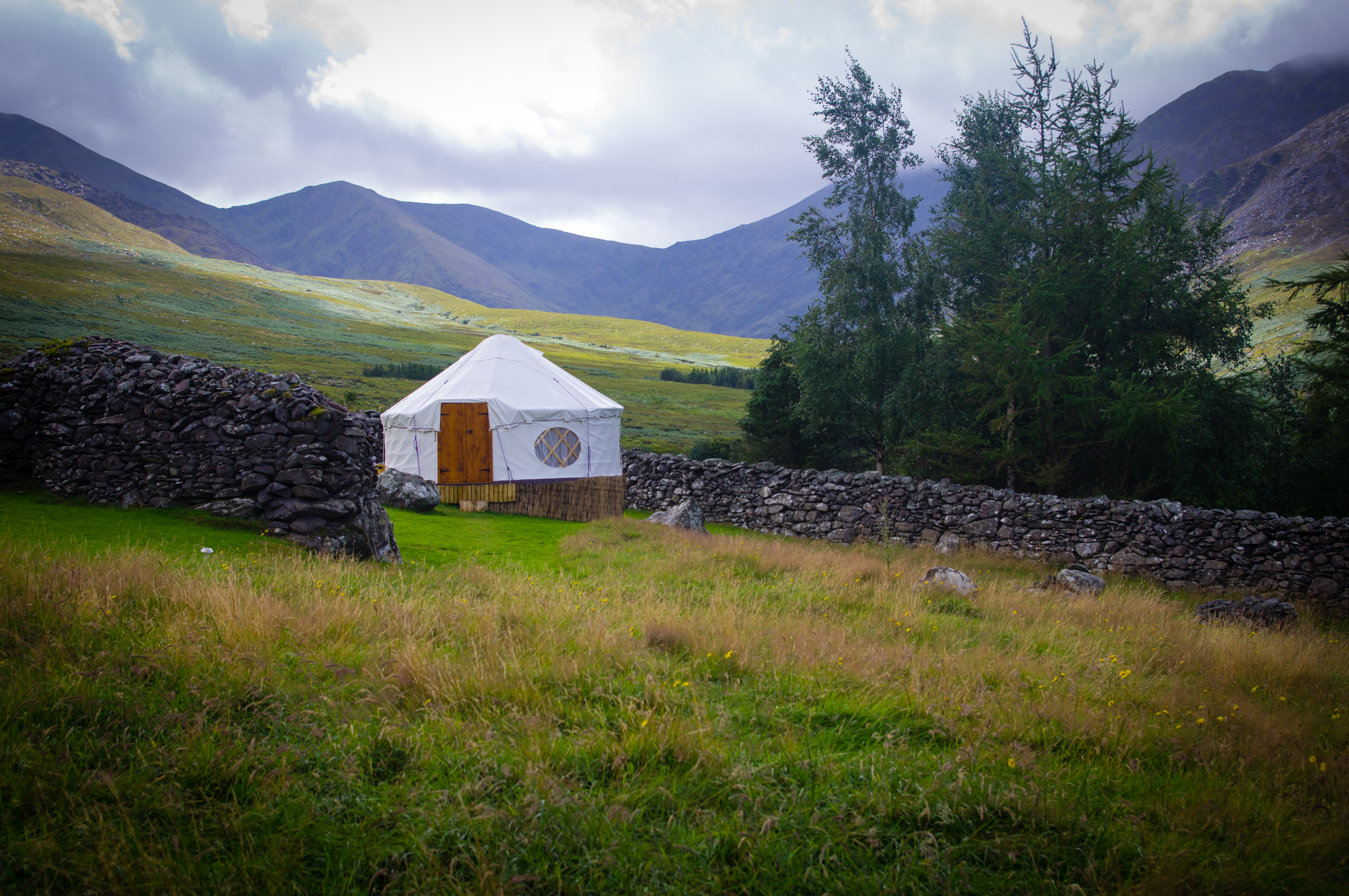
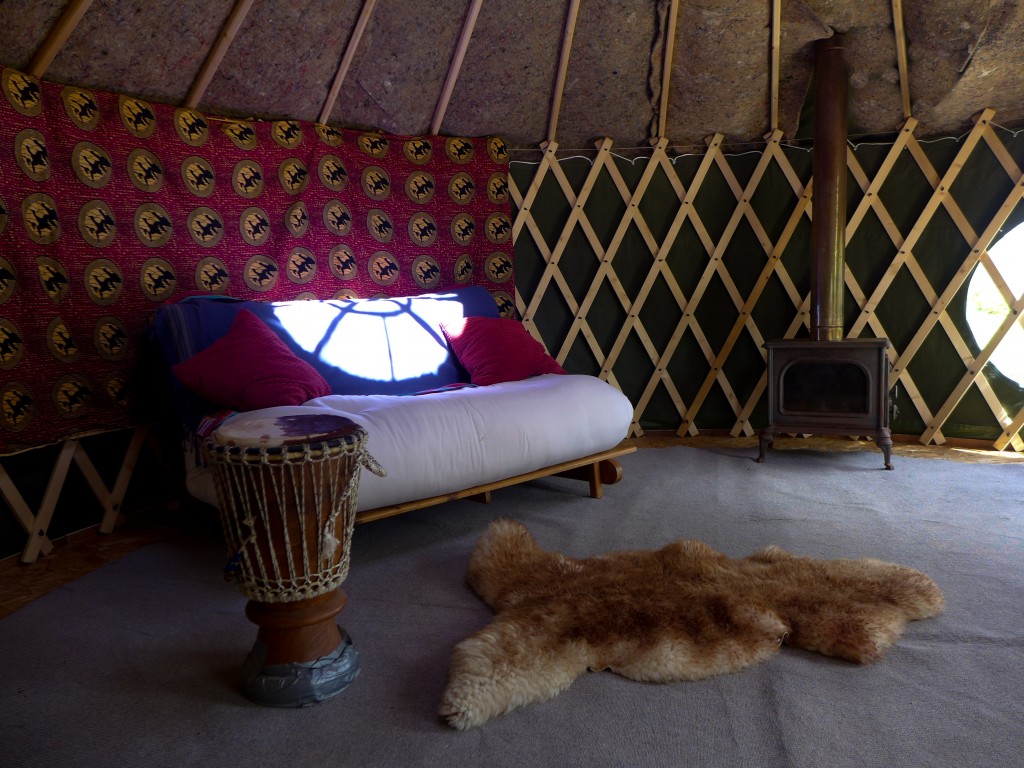
Tomorrow morning, I am heading to the Burren to collect hazel for a yurt-making workshop to be held later this month. There is something very natural and deeply satisfying in building a shelter. To go to the woods, select and cut sticks, peel bark, measure, shape, make simple connections with cord. To create a special little world in which to dwell and dream.
It is more than keeping the rain off our heads. It is creating and defining space, shaping the world around us. It is an instinctive architectural process. When we lay a towel on the beach we define space in a simple way. True it does keep the sand off our bottoms, but it is more than that and we all know it. The area of architecture I have ended up working in is mobile structures: yurts, tents and simple shelters. I like structures that kiss their surroundings and sit lightly on the ground, move and leave only the vaguest memory behind.
My journey with yurts began many years ago. I became interested in them as a student and years later started making them as a way of enticing my city girl partner into a life of camping. My fascination with these structures and the people who live in them has grown over the years since. Circular structures are beautiful but also demanding, pulling our focus to the centre, democratic, ordered and powerful. In Mongolia there is a strict order to the layout of a Yurt or Ger as it is known. The door always faces south. Atthe north is the Altar. Men are to the west and women in the east, always sleeping with heads to the north. In between, are places for children, guests, visitors and possessions. In a Yurt the whole universe is represented. The roof is the sky or heavens, the crown is the sun – the entrance to the upper world. The walls are the world tree or ladder by which one ascends to the upper world (something which Mongolian Shamen do in a trance state passing through the crown). At the centre is the sacred hearth. It contains the five basic elements: earth, wood, fire, metal in the grate and water in the kettle, on which offerings are burned each morning. In this way the spiritual is a part of the everyday. Circulation is always clockwise, and many other mores and traditions dictate how people interact with one another. It is for example considered very impolite to knock on the door of a Yurt. One should simply enter. To knock is to question a host’s generosity.
Shelter will always be given even to a mortal enemy. Yurts are also extremely practical dwellings. They offer protection from a very harsh environment and are perfectly suited to the lifestyle of nomadic people. It is this combining of the spiritual practice with the everyday which holds my attention. It is something common with all vernacular or traditional housing. In Ireland the long cottage with stone hearth, settle and holy lamp could be seen in the same way. It is these questions about how we dwell and shelter and what we truly need to thrive as people, which should be at the heart of the debate surrounding the current housing situation. It is worth remembering that the word Ger in Mongolian does not actually describe a structure at all but translates simply as home.
Nick Clayson is an Architect, Craftsman and Proprietor of Bigfoot Yurts. facebook.com/bigfootyurts


We’ve all been there, walked into a room where we feel we could cut the atmosphere with a knife. Everything that happens in a space leaves a residual imprint, and traumatic events in particular, whether known or unknown, can leave their mark.
When we started doing House Energy Clearing, we were amazed by the numerous stories of those who experience discomfort in the atmospheres of their homes. Often feelings that they can’t quite put their finger on a reason for. We see these as indications that the energy in a house needs to be cleared and balanced and to create a space that instead of holding people back, enables people to be in an optimum state of wellbeing and happiness. Your home is your sanctuary for rest and rejuvenation and you deserve for it to feel that way.
Our House Energy Clearing uses a unique blend of shamanic, sound and energy healing techniques to clear and re-energise a house with a more nurturing, energetic imprint that serves to benefit those who live in the space. The reason people call upon our assistance is varied and each clearing is a new adventure.
However, the results are similar – clear and transmute the energy that is creating any imbalance and then consciously imprint the space with divine energies and intentions such as love, joy, peace, laughter, calm, playfulness – whatever the home owner feels is the right energetic imprint for their journey in life.


By Edel Cleary
What I have found, in the past 18 years of studying and working with feng shui, is that it is deeper, more profound, and yet simpler, than any one explanation can encompass. The energy we surround ourselves with, physically, mentally, emotionally and spiritually, how we internalise this and reflect it back into our world is a process as simple and vital as breathing.
Feng shui provides us with a system through which we can analyse what it is about our homes that is working for us and what might be impeding our progress. Feng shui is about dynamic balance, not static perfection. The energy in every area of our lives ebbs and flows, exactly as it does in nature and that’s just how it should be! It’s a process of germination, birth, growth, blossoming, shedding and dying back. If we were to live in static perfection there would be no growth.
Feng shui provides us with a prism through which we can gain clarity on our place in this process so that we can relax and go with the flow while still having a firm hand on the rudder. Not floating aimlessly, but moving gently forward, easily and effortlessly on our journey through life. The most important thing to remember is to surround yourself with what you love. Go through your space regularly and weed out anything that is no longer ‘you’, ensuring each element feels uplifting and joyful along the way.


By Amanda Collins
A colleague once hired me to Feng Shui her neighbour’s home as a gift to him. The day I arrived at his house, he was completely drunk. I reminded myself that I was there to be of service and that this is why I do what I do so I trusted in the Divine process and went ahead.
“What is this Feng Shui stuff anyway?” he asked. As I walked in, I felt a sharp, stabbing sensation in my chest. I looked around and there was a machete on the wall pointing right at me, along with other knives. My new client had been sharing that no one came to visit him anymore, not even his children or grandchildren. It had been years since he had seen them. I explained that the knives on the wall were keeping away good energy and the people in his life. The next thing I knew, he was ripping the knives off the wall and throwing them out the front door! I knew he was ready for change.
His home was a Feng Shui nightmare. Artwork consisted of knives, guns and pictures of when he was in the army. His past had not been a kind one. His home needed serious love. It was cluttered, far from clean, in need of repair, painting and new live plants.
This website uses cookies to improve your experience. We'll assume you're ok with this, but you can opt-out if you wish. Accept Read More