


Date: August 31st – September 3rd, 2016
Location: Swynnerton Lodge, Navan Co. Meath
Join Dan on this event which promises to be transformative and informative for yoga teachers as well as the general public. In Dan’s words: “I am so excited to be working in Ireland for the first time! We will be exploring how Breathwork can cause healing and growth in body, mind and spirit!”
The event costs €250 for the whole workshop. It is possible to do one day only – cost €100. Check out breathmastery.com for more info about his work.
To book contact Marion via email at heavensbreath@rocketmail.com or by phone at 0876524827

From our Winter 2015/2016 issue. Be the first to read the next issue of Positive Life in print – Subscribe.
By Hans Wieland
Before I discovered the taste of black coffee as a student, I was allowed as a teenager to have “Muckefuck” or “Caro-Kaffee”, a cereal coffee made from the roots of chicory, ground rye and barley without the addictive caffeine. It was much later in life when I started growing chicory, radicchio and endive as part of my obsession with taste and flavour for salads. They’re a fantastic crop for winter harvesting in my polytunnel and I love the bitterness of their leaves.
Chicory, radicchio and endive aren’t common vegetables in Irish gardens, but that is going to change. Organic garden queen Joy Larkcom, asked recently at a public interview at the GIY Growfest in Waterford about what she wanted to see happening, said, “I would hope gardeners grow more chicory, because they have many merits. They are naturally robust, are mostly easily grown, have few pests and utilise ground that would otherwise be idle in winter.”
Chicories are such a useful crop. They provide salad leaves from autumn right through to early spring if you stagger your sowing and choose varieties that mature at different speeds. I sow into modules late July and early August and then plant early September into ground recently vacated by broad beans, garlic or potatoes. They are not particularly difficult to grow nor fussy about soil type and are very hardy.
The chicories (Cichorium Intybus) are wonderfully diverse and come in several distinct varieties. Radicchio is the popular Italian name for chicory. Rossa die Treviso, Palla Rossa and the green leafed Sugar Loaf are my favourites. Endives (Cichorium Endivia) are another group in the chicory family and like the broad-leafed Nuance and the curly-leafed Pancalieri. The latter is virtually self- blanching.
I also try to produce ‘Chicons’ by forcing chicory in late autumn and winter. I lift the thickest roots, cut the leaves back just above the roots and forced them in a pot of compost in a dark, warm place. It takes about three weeks to produce the ‘chicons’.The ‘Witloof’ type Metafora is ideal for this purpose.
Healthy, nutritious bitter greens. Bitter greens have a bold flavour that may take some getting used to but the health benefits are worth the effort. Bitter greens are packed with vitamins A, C and K, and minerals like calcium, potassium and magnesium. Filled with folate and fibre and low in fat and sodium, they are a nutritional powerhouse.
As mentioned in Colleen’s article also in this issue, eating bitter food activates taste buds that simultaneously stimulate enzyme production and bile flow, promoting healthy digestion. The better your food is digested, the more nutrients you’ll absorb from your food. They’re digestive magic. What’s more, bitter greens also promote natural detoxification of the liver, regulating cholesterol, balanceing hormones and detoxifying the blood. It all helps digest fats in a more efficient manner.
They’ll balance your taste buds and reduce cravings. Ayurveda recommends we consume all tastes for better health: sweet, salty, sour, bitter, pungent, and astringent. Our western diet primarily consists of sweet and salty tastes and it is to our benefit to eat foods that activate all of our taste buds. It’s also been suggested that consuming bitter greens may also reduce food cravings and aid in weight loss!
Hans Wieland has been working and teaching at The Organic Centre since 1997. Essential reading: The salad garden by Joy Larkcom. And grab your own organic seeds for chicory, endive and radicchio. Book and seeds available from: theorganiccentre.ie
From our Winter 2015/2016 issue. Be the first to read the next issue of Positive Life in print – Subscribe.

By Colleen Kennedy
Long before the advent of science labs, mass spectrometry/gas chromatography and isolated compounds, the traditional medicine man or woman relied on the art of taste to decipher the quality and use of a plant. Now, I’m sure there may have been a few human casualties along the way as some of the most potent toxins come from the plant world, but the essence of this art is still used today, and now. combined with the knowledge of the science labs, we’re able to understand and utilise plant properties without the casualties!
All of the worlds herbal traditions, from Ayurveda to TCM, Native American and our own Irish Herbalism use a system of communicating through taste and using that taste essence return our bodies to a state of balance. Through scientific research, we can identify phytochemicals that correlate to these tastes and to justify and rationalise our use of these plants. But we must take our hats off to our ancestors who had this art all figured out long before we all came along!
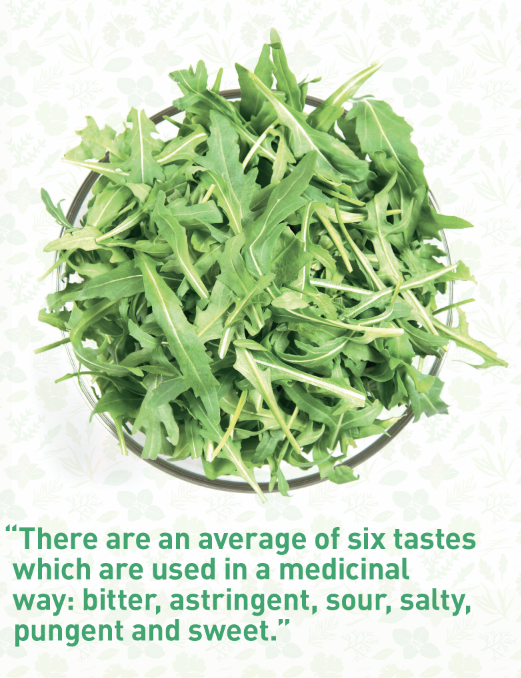
There are an average of six tastes which are used in a medicinal way; bitter, astringent, sour, salty, pungent and sweet. In this particular article, we’ll be getting bitter! Since that taste is probably most lacking and most beneficial to the typical Irish diet.
Bitters are a flavour and phytochemical component in foods and herbs that exert a very specific action on the digestive system. We have overloaded our taste buds with so many synthetic additives, preservatives and sweeteners that no one likes to taste that bitter flavour anymore, when it’s so crucial to the efficiency of our digestion. On stimulation of the bitter receptors in our tongue, a message is sent to the brain to release a myriad of digestive enzymes from the mouth to the stomach, pancreas and liver.
Bitters stimulate the secretion of the hormone gastrin, which regulates the production of gastric acid. Inadequate stomach acid will prevent the uptake of minerals, which in turn can rob the body of essential nutrition, even if those nutrients are being consumed as foods or supplements. Low acid also weakens stomach tissues, and is often the foundational cause of oesophageal reflux – though most people mistakenly believe they have too much acid. As we age and due to stress and eating on the run, we have a tendency to actually produce less stomach acid.
Bitters act on both the pancreas and liver/gall bladder, helping to normalise blood glucose levels, and promote the production and release of pancreatic enzymes and bile, which ensure good digestion of fats and oils. From a traditional energetic perspective, an out-of-balance liver can be associated with anger and frustration, and bitter herbs can often be a part of a prescription to help balance this energetic symptom of liver congestion.
So where do we find this bitter? Chicory, endive, mustard greens, watercress, wild dandelion leaves, dandelion root and rocket are all good bitter foods and can be eaten in small amounts with a meal to have a therapeutic action. This is where the ‘salad before a main meal’ concept came from.
We also have some very bitter tasting herbs, Gentiana lutea (Gentian), being one of the most bitter. Barberry, Dandelion root, Centaury Goldenseal, Yarrow and Yellow dock are other examples, though they have varying degrees of bitter principles and other synergistic attributes too.
Bitter tinctures can be used in smaller doses 10-15 minutes before a meal to stimulate the digestive juices, but are also added to a formula in larger amounts for a cooling, detoxifying and antimicrobial effect. The cooling effect needs to be balanced for a certain type of constitution as it may be too cooling and drying for some types.
It’s interesting that the bitter flavour is one we often avoid and much like the bitter side of our emotions, may perhaps be better faced up to, acknowledged and thanked for the lessons in life and in medicine we can learn from them.
Colleen Kennedy graduated in herbal medicine and naturopathic nutrition from CNM and also lectures in herbal medicine at CNM Galway and Dublin campus. naturopathy.ie
From our Winter 2015/2016 issue. Be the first to read the next issue of Positive Life in print – Subscribe.

While vitamin and mineral supplements are extremely valuable as tools for maintaining health, their effectiveness can be limited if your overall nutritional foundation is poor. Realising this, a thoughtful company called Terranova designed a solution for you. ‘Life Drink’ is an ideal foundation not only for its own nutritional benefits, but also to enhance the effectiveness of a person’s normal food supplement programme.
Life Drink features a balanced pea and rice protein blend; the antioxidant powerhouse stabilised rice bran; spirulina and chlorella; ten different freeze dried super-greens; ten different freeze dried super-berries; freeze dried reishi and shiitake mushrooms; vegetarian omega 3, 6 and 9 oils; seven different digestive enzymes; and five different probiotic species with prebiotics! This combination of ingredients stands out because it isn’t provided by even the most comprehensive multivitamins. It’s light and easy on the stomach to take, quick acting, with people feeling results within thirty minutes and comes in jars as well as handy sachets you can pop into your bag.
Terranova are a great little brand who want to make nutrition work at a molecular level, getting right into the tiny, nitty gritty workings of our bodies and as a result, take great care at every step of the process. It makes for an interesting and authentic story as well as contributing to the health benefits of their products. The company was founded in 2008 by Stephen Terrass, the former Technical Director of well-known supplement brand, Solgar Vitamins UK. Going out on his own, Stephen set out to create Terranova as one of only a few broad-spectrum supplement companies, to use no fillers, to be 100% vegan friendly and to offer supplements that were perfect for children as well as general products for adults.
Their ingredients have a wonderful journey before they reach those little bottles too. Many are either certified organic or ethically wildcrafted. The 90-acre certified organic herb farm of their primary botanical supplier, is a secluded farm in Oregon, surrounded by native forest and the Sandy River canyon. They chose them as their supplier as every crop is nurtured in a pristine, chemical-free environment and harvesting only happens when the plants have reached their peak levels of bio-active markers.
And they care about their ingredients at the next stage too. Air, oven and and spray drying are the standard commercial methods to dry plant materials but as this can degrade important compounds and even alter a plant’s delicate biochemical balance, many of Terranova’s botanicals are freeze dried to retain all of the good stuff in order to benefit you.
The next time you pick up a supplement in a shop, do a little digging to see how its been made. Ingredients and production methods can make a huge difference in the potency and value of a product so it’s worth knowing what you’re buying. The story and the methods just might be the secret behind their impact.
From our Winter 2015/2016 issue. Be the first to read the next issue of Positive Life in print – Subscribe.

By Sandy Newbigging
We become what we focus on the most, so the Body Calm technique offers simple ways to connect with the power of meditation and embody a series of positive virtues and focus points. When thought and felt regularly, these can transform your belief system and mental and emotional habits, in turn affecting your physical wellbeing.
Over the years I’ve had the opportunity to observe a number of common beliefs held by people struggling with a range of health complaints, with some of the most harmful being, ‘I’m unsupported’, ‘I’m not good enough’, ‘I’m unworthy’ and ‘I’m weak’. The purpose of meditation is to rest within your real Self: the calm consciousness that is always within you, and discovering the aspect of your being that never gets stressed, sick or suffers. Even if your body is uncomfortable or presenting undesirable symptoms, you can find wellness within.
Body Calm meditation helps you to befriend your body, give it the rest it needs to recover and improves the communications between mind and body. With regular practice, it helps form new, improved beliefs; ones that encourage physical health.
The ‘CALM’ part of Body Calm stands for ‘Conscious Awareness Life Meditation’ and involves two main elements:
1. Being Gently Alert with your Awareness Wide Open – a technique I affectionately call GAAWO.
2. Occasionally thinking Body Calm Thoughts that help to heal the sources of stress.
Calm Thoughts are short statements used during open and closed-eye meditation that act as the antidote to any attitude that might be having a detrimental effect on your body or behaviours, and consists of three components: I am + Positive Virtues + Focus Points.
Despite being two of the shortest words in the English dictionary, ‘I’ and ‘am’ together are two of the most powerful. When you think or say ‘I am’, you are referring to the absolute aspect of your Self that is unconditioned consciousness, unbounded being and infinite awareness. ‘I am’ is pure, powerful and infinite. To harness the power of this statement, we marry ‘I am’ with a series of ten positive virtues. These encourage the mind to form healthier beliefs and help you to embody healthier states of being that support good health.
Each Calm Thought also has a recommended location within or around your body on which to put your focus when thinking it. With the inclusion of these focus points, the power of the Calm Thoughts is magnified significantly by working in a number of ways. All of the focus points are symbolic and appeal to the mind–body connection. For example, when it comes to the interconnectedness between the mind and body, most people I meet who feel they are ‘unsupported’ also tend to present lower back problems. So thinking ‘I am supported’ while focusing on the base of the spine can heal the belief and perception that you are unsupported.
By working in harmony with the symbolic nature of the mind–body connection, you reduce mental and physical resistance and more easily shape a new, healthier belief system and a more supportive attitude towards yourself and your body.
Sandy’s new book Body Calm is out now and is full of more great tips and advice on using the Body Calm meditation technique. sandynewbigging.com

By Caoimhe Harrison
We’ve all been there, trying every diet under the sun. So it begs the question – do diets work?
It seems the only thing they are successful at is making people feel like failures when they can’t stick to them or the weight creeps back on and once again we are back in search of the new and latest diet. We are constantly weighing ourselves and allowing that number to determine our self worth. Yet on some level, we inherently know it’s madness giving so much power to this number.
If we stop for a second and think how much better would my mood be today if I hadn’t weighed myself? The answer is: no feelings of self-guilt or shame. The flipside of course is that if we see the ‘magic number’ we are hoping for we are elated. However this feeling of delight is very short lived as that number has the power to relentlessly take the wind from our sails at any moment should it increase even slightly.
When will we stop looking for the answer where it isn’t? I invite you to consider stopping this number from deciding your self worth. Regardless of how many times you have given it away – take back your power now. Taste the liberation!
Look around you at the people who profess having the perfect number. Are they blissfully happy with perfect lives? For a permanent change, you must address the cause not the symptom. The cause is your mindset. Start today.
Caoimhe Harrison is a Master Practitioner for eating disorders and all food, body and weight issues.
This website uses cookies to improve your experience. We'll assume you're ok with this, but you can opt-out if you wish. Accept Read More